AAR - UIC - BS - EN - IRIS - TB - GOST - JIS
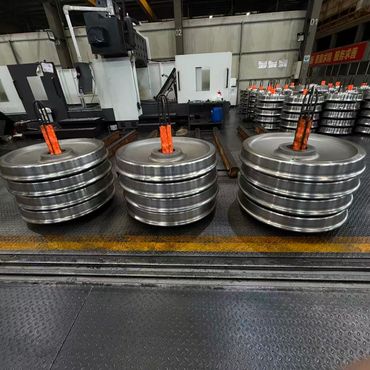
WA 762mm AAR Class C Wheel Wagon Freigth

The standard for freight cars is available in standard sizes of 28", 33", 36", and 38"
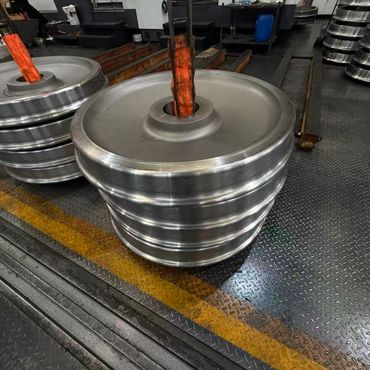
WA 838mm AAR Wagon Wheel Freigth

AAR Steel Classes (A, B, C, L, D): Wheels are classified by the carbon content in the steel, balancing wear resistance and thermal capacity.
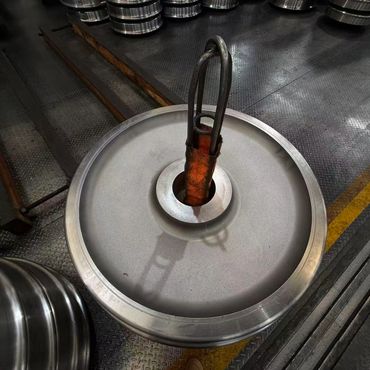
WA 914mm AAR Freigth Wagon Wheel

Class B, C, and D wheels are most commonly used in freight cars and locomotives, as governed by specifications like AAR M-107 Specification.
WA 950mm AAR Freigth Wagon Wheel

Forged wheel for high capacity Freight Wagon. Standard AAR.
WA 1016mm AAR Locomotive Wheel

All freight car wheels nabufacture for AAR interchange service must be heat-treated and of a low-stress design.
WA 1095mm AAR Locomotive Wheel
AAR M-107 Standard. For Freight also standards: EN-BS-IRIS-TB-UIC-GOST-JIS
WA 860mm UIC812 Wheel
WA 920mm EN13262 Wheel

WA 950mm BS Wheel
WA 950mm BS Wheel

QUOTE AXLE PROJECT WITH STANDARD NEED. AAR - EN - UIC - TB/T
WA 2435mm Axle AAR Grade F

Grade F (Double Normalized and Tempered): The absolute standard for typical heavy-duty freight operations. Any freight axle with a nominal diameter over $6\frac{1}{2}\text{ inches}$ at the center must be Grade F. The process utilizes two distinct normalizing cycles (the second at a lower temperature to radically refine grain structure) followed by tempering to relieve thermal stress.
WA 2170mm Axle EN13261 EA4T

EA4T is a high-performance Chromium-Molybdenum (Cr-Mo) alloy steel. The addition of chromium increases hardenability and wear resistance, while molybdenum enhances toughness and counters temper brittleness.
WA 1720mm Axle TB/T 2945

Its primary historical framework was originally modeled on a modified version of the American AAR M-101 specification. The foundational standard (TB/T 2945-1999) specifically standardized the highly ubiquitous LZ50 carbon steel grade, which remains a massive cornerstone for Chinese rolling stock, freight wagons, and passenger coaches.
WheelSet for Wagon

Wheelset Standard gauge
Wheelset for Passenger Coach
The gauge wheelset normally manufacture between 935mm to 1676mm.
Wheelset for Locomotive

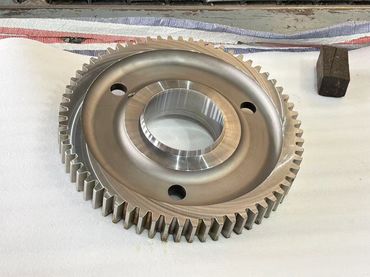
The axle of the locomotive wheelset is equipped with transmission gears to provide traction during the locomotive's travel. The locomotive wheels have a larger wheel diameter, more production processes, and a complex assembly process.